

Summary
When talking about fluid management and handling in the field industrial, chemical e pharmaceutical, the choice of the right centrifugal pump has important repercussions on the safety, reliability, and operational efficiency of the entire plant.
In CDR Pompe Over time, we have built a solid reputation both in Italy and internationally, thanks to a rigorous design approach, highly specialized production, and constant technological research aimed at innovation and sustainable economy.
One of our company's distinguishing features is the ability to offer highly customized solutions, developed tailor-made based on the specific applications and operating conditions of each individual client. Thanks to a qualified technical department and state-of-the-art production facilities, the company is able to design centrifugal pumps from drawings, in various construction configurations and materials, always guaranteeing high performance and durability over time, even in the most demanding applications.
What is a centrifugal pump and how does it work?
A centrifugal pump is a fluid dynamics device that uses the mechanical energy supplied by an electric motor to move a fluid. Its operating principle is based on the centrifugal effect generated by the rotation of an impeller, aed wheel that draws the liquid from the center (axial suction) and pushes it towards the periphery (radial or tangential discharge).
During this process, mechanical energy is initially converted into kinetic energy by the impeller's movement and subsequently transformed into pressure energy within the pump casing, or volute, which has a progressively increasing cross-section.
In detail, the rotating, rotating at high speed, generates a low-pressure zone at the pump inlet, thus promoting the suction of liquid from the upstream circuit. The fluid, intercepted by the Impeller curve options, acquires speed as it is dragged towards the periphery of the impeller itself, under the action of centrifugal force. Upon reaching the outer edge, the liquid is expelled with a certain velocity and directed into the scroll, a progressively widening chamber that slows the flow and transforms the remaining kinetic energy into pressure energy. This pressure increase allows the fluid to overcome the resistance of the delivery circuit and reach the point of use.
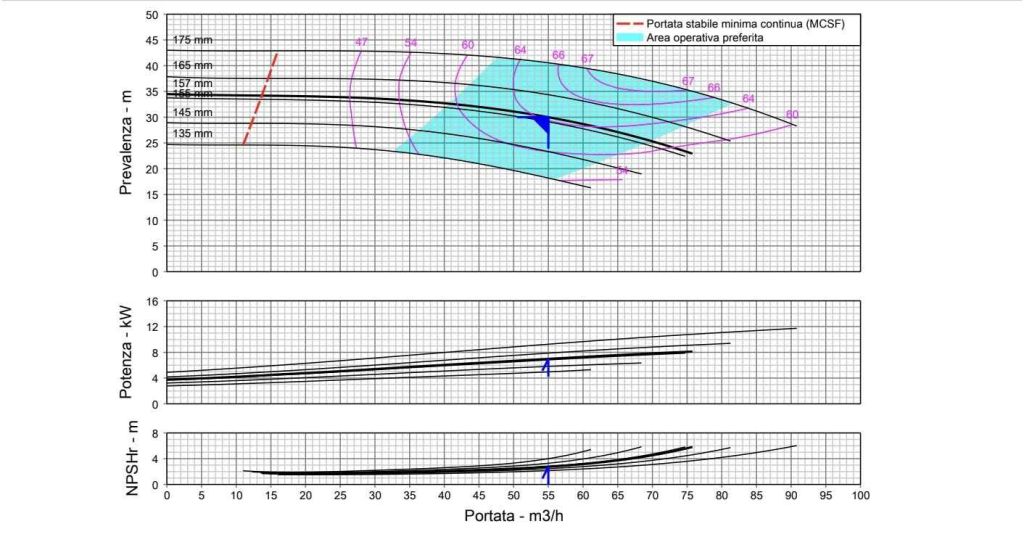
The trend of this process is described by pump characteristic curve, which represents the relationship between the delivered flow rate and the developed head, two essential parameters for the correct selection and configuration of a centrifugal pump according to specific system requirements. The more the operating point is centered on the curve, the greater our performance will be in terms of performance, energy saving, and long pump life.
Compared to Volumetric pumps e peripheral pumps as discussed in previous articles, centrifugal pumps are more efficient in high-flow applications.
The main components of a centrifugal pump
The structure of a centrifugal pump is composed of several essential elements, each with specific functions and designed to ensure efficiency and longevity. Specifically, the main components of a centrifugal pump that directly influence performance and are the subject of continuous technological evolution by our Research and Development department are:
- Impellerit is an impeller that's tasked with transferring mechanical energy to the fluid. It can be of various types (closed, open, single-channel, backward-curved, vortex) depending on the flow rate and pressure requirements.
- Pump housingIt is the casing that contains the fluid and guides the flow from the impeller to the discharge. It is specifically designed to withstand high pressures and temperatures.
- Scrollconsists of a spiral section of the pump body with an increasing cross-section, which is essential for the efficiency of the transformation of mechanical energy into hydrodynamic energy
- Tree that connects the impeller to the motor, transmitting the power needed for rotation.


Factors Affecting the Choice of a Centrifugal Pump for Your Company
The Sales Department and CDR's Technical Office they are always available, with commitment and professionalism, to advise the customer in choosing the right centrifugal pump for the specific needs of the system. We mentioned that this type of pump has many different variants (open or closed impeller, horizontal or vertical, magnetic drive or mechanical seal), and consequently, before installation, various parameters must be taken into consideration, including:
- Fluid temperature: in case of high temperatures, materials that can withstand heat and adequate cooling systems are required. For temperatures above 65°C, for example, it becomes important to maintain good supply pressure to avoid cavitation; on the contrary, in the event of extremely low temperatures (-100°C), CDR offers configurations in Stainless steel Suitable for working in these environments;
- Required flow rate and headThe system's characteristics determine the specifications of the pump needed to meet the flow and pressure requirements.;
- Intake conditions: altezza di aspirazione, pressione disponibile e NPSH (Net Positive Suction Head) sono fondamentali per evitare fenomeni di cavitazione che danneggiano la pompa;
- Installazione meccanica: posizione dell’albero (orizzontale o verticale), tipo di fondazione, modalità di accoppiamento motore-pompa (diretto o con giunto), e disposizione delle tubazioni;
- Normative di sicurezza e certificazioni: in ambienti con atmosfere potenzialmente esplosive (ATEX) o per fluidi tossici, è necessario adottare pompe certificate e con sistemi di tenuta specifici;
- Manutenzione e accessibilità: pompe con supporto back pull-out facilitano gli interventi senza smontare le tubazioni. Da valutare in base al tipo di impianto sul quale la pompa centrifuga andrà installata;
- Presenza di solidi in sospensione: nei casi di lussi contenenti particelle solide vengono richiesti giranti e design adeguati per prevenire l’intasamento e l’usura. del prodotto.
The CDR centrifugal pump range: high technology for critical applications
CDR Pompe offre una gamma completa e altamente specializzata di pompe centrifughe, progettate per rispondere alle esigenze più complesse di impianti industriali con alte portate e condizioni operative critiche. La produzione comprende pompe a mechanical seal and magnetic drag, disponibili in diverse configurazioni orizzontali e verticali e realizzate in materiali selezionati per garantire resistenza chimica e meccanica.
Le pompe a trascinamento magnetico sono il vanto della produzione CDR, nelle quali il moto rotatorio viene trasmesso alla girante tramite un giunto magnetico. Eliminando la necessità della tenuta meccanica, si riduce enormemente il rischio di perdite e contaminazioni. Di conseguenza, questa tecnologia risulta ideale per fluidi corrosivi, tossici o pericolosi, per i quali la sicurezza e l’affidabilità sono fattori imprescindibili. Le parti a contatto con il fluido sono realizzate in stainless steel o in materiali termoplastici tecnici come PP, PVDF o PFA, selezionati in base alla natura del liquido da trattare.
Le linee di pompe centrifughe CDR
In base alla tipologia dell’impianto e alle esigenze operative del cliente, le gamme di pompe centrifughe di CDR si dividono in 4 categorie:
- Pompe orizzontali a tenuta meccanica: monostadio, conformi alle normative ISO 2858 e ISO 5199, disponibili anche con certificazione ATEX per ambienti a rischio esplosione.
- Pompe orizzontali a trascinamento magnetico: con parti bagnate in acciaio inox o materiali plastici, progettate per installazioni dirette sulle tubazioni e per applicazioni con fluidi aggressivi o estremamente pericolosi.
- Pompe verticali a trascinamento magnetico: realizzate su misura, con parti a contatto con il fluido in PVDF, adatte a condizioni di basso NPSH e fluidi estremamente pericolosi.
- Custom Pumps: progettazione e realizzazione di pompe centrifughe verticali e orizzontali personalizzate per applicazioni critiche, con materiali e configurazioni su misura.
Questa ampia offerta permette a CDR Pompe di fornire soluzioni ottimali per ogni tipo di impianto, garantendo elevate prestazioni, sicurezza e durata anche in condizioni operative gravose. La possibilità di scegliere tra versioni in acciaio o rivestite LINED in PP, ETFE, PVDF o PFA consente di adattare la pompa alle specifiche caratteristiche chimico-fisiche del fluido, assicurando la massima compatibilità e protezione dall’usura e dalla corrosione.
The pompa centrifuga CDR rappresenta una soluzione top di gamma per applicazioni ad alte portate, grazie alla combinazione di tecnologia avanzata, materiali di alta qualità e un’offerta completa che copre ogni esigenza industriale. Grazie a un team di esperti e a una rete di distribuzione globale, l’azienda è in grado di supportare i clienti in ogni fase, dalla selezione del prodotto alla manutenzione post-vendita.
Per tutte le informazioni necessarie, fissa un appuntamento e organizzeremo una consulenza dedicata!